For
Families
We work with families to build on strengths, repair relationships and create opportunities for change. Our aim is to help children and young people develop safe, supportive, relationships with their parents and carers.

WE WANT FAMILIES TO SUCCEED
We listen carefully to your experiences, help you learn new skills, gently challenge unhelpful patterns, and offer different ways of thinking. We will always work with respect for your family, culture and individual needs. We are not going to blame or judge. We want families to succeed.


WHAT IS
FUNCTIONAL
FAMILY THERAPY?
Functional Family Therapy (FFT) is a programme designed to support families and help young people who may be facing emotional, social, or behavioural challenges both at home and in the community.
FFT works well with families of all shapes and sizes and is especially helpful when family relationships are strained.
Functional Family Therapy focuses on strengthening family bonds, improving communication, and building positive solutions together.
We currently deliver three different variations of Functional Family Therapy:
1. Functional Family Therapy – A short‑term therapeutic programme that helps families reduce conflict, improve communication and strengthen relationships so young people can thrive.
2. Functional Family Therapy Child Welfare – A version of FFT designed to support families where there are safeguarding concerns, helping them stay safely together and reduce the risk of children entering care.
3. Functional Family Therapy Extra Familial Harm - A specialist FFT model that supports families when young people are at risk from influences outside the home, such as exploitation or unsafe peer groups, helping parents regain connection and protective influence.

WHO IS FFT FOR?
The programme is for young people aged 8 to 17 and their significant family members (ages differ depending on which FFT is taking place) .
It’s designed to help when:
Family relationships are struggling, and there’s a worry that things might fall apart or that a young person might need extra support outside the home.
A young person is making choices that could get them into trouble, and the family wants help to guide them in a more positive direction.
A young person often goes missing or is spending time with people who might not be safe, and parents feel they’re losing influence or connection with their child.
The programme helps families work together, rebuild trust, and find better ways to support each other.

WHAT TO EXPECT?
Functional Family Therapy is a short-term programme that helps families work through challenges together. It usually includes 12 to 20 sessions over about 4 – 6 months. Sometimes more sessions can be added if needed, depending on the type of FFT taking place.
We know every family is different, so we make sure our sessions fit around your daily life. Our friendly therapists can meet you at home or in a local place that’s comfortable for you. We always include the whole family, especially the people who play an important role in how everyone gets along.
Before we begin, one of our therapists will meet with you to explain how Functional Family Therapy works. This is a great time to ask questions and decide if it feels right for your family.

The Three Main FFT Phases
1. Engagement and Motivation
We get to know your family strengths and understand what’s been difficult. We focus on building trust, confidence and hope that positive change is possible
2. Behavioural Change
We help families improve communication, reduce conflict and develop practical skills to manage challenges, building on your existing strengths.
3. Generalisation
We support you to maintain progress by using new skills in everyday life and identifying ongoing support inside and outside the family.

Support, Reviews and Progress
FFT is a well‑supported model. Therapists receive regular supervision and consultation to ensure high‑quality, thoughtful support for your family.
At the start and end of the programme, family members complete short questionnaires. These are not ‘assessments’ but they help us understand how things are changing and review progress together.
Confidentiality and Record Keeping
Family Psychology Mutual (FPM) keeps secure records and shares progress updates with the referring local authority. Information is shared only with consent, unless there is a risk of serious harm, when we are required to act to keep people safe.
At the end of the programme, your therapist will write a summary report of the work completed.

Frequently Asked Questions
-
No, this doesn’t mean your family isn’t functional. Functional Family Therapy focuses on strengthening family bonds, improving communication, and building positive solutions together.
-
We offer a confidential service. We will only break this confidence if there are risks of harm to anyone. In a case like this we would contact the case holder from the Local Authority. Therapists make a file note of each visit on the case management system for Children’s Services. Therapists will discuss the skills they have used or are intending to use with their supervisor, colleague therapists and the FFT consultant. This is to ensure that they are keeping the therapy on course and using the right skills to make progress.
-
Yes, you can call your therapist and update them. They may well need to pass this information on to the case holder too. We only share information that is necessary to keep families safe. If you cannot get hold of your therapist you can call our office and leave a message or alternatively contact your case holder in the local authority.
-
Questionnaires are used as part of the clinical assessment of the whole family at the start of the therapy. They can help your therapist to understand where family members are at and can also highlight issues and risks to be aware of. These are repeated at the end of the therapy, and your therapist can show you a graph that should be able to show how much you and other family members have progressed.
-
Yes, you can comment or complain about how the service is delivered. Feedback is important and we are keen to learn if we are making progress or not. We don’t always get things right and if we make mistakes we will apologise to you. At the end of the therapy, we will invite you and your family to give feedback via a satisfaction questionnaire.
-
Our therapists are trained in the model and will be working hard to make the changes that you and your family want. We expect to treat you all with respect and dignity and in return we expect the same from you. It is very rare that we change a therapist through the course of therapy. On rare occasions a therapist may be sick or leave before the therapy is completed and the therapist will need to be changed. If you are really unhappy and want to change therapists, we might ask that you meet with the therapist and their supervisor to see what might be done.
-
We know that making changes can be overwhelming and so we will concentrate on the main or most important issue only at first. As the therapy progresses, we will see if more behaviours can be changed by applying a similar approach. Your therapist will ask you to try new ways of reacting and responding to issues and will help you with techniques to try. Your therapist may also give you some homework to try out between sessions.
-
In most circumstances you are able to request further sessions called boosters in the six months after your case has been closed by us. You can ask for up to three to four sessions. These might be to refresh your skills, to deal with a new issue or to have a reset of your confidence in the skills you learned and how to use them appropriately.
-
It usually includes 12 to 20 sessions over about 4 – 6 months, but more sessions can be added if needed.
-
Our friendly therapists can meet you at home or in a local place that’s comfortable for you.
-
Your therapist will arrange to see you weekly at a time that suits you both.
-
Yes. We always include the whole family, especially the people who play an important role in how everyone gets along.
-
Yes, it is really important that a parent/carer and child/young person can be present for each session.
-
Yes, you can call or text your therapist. Ideally with at least 24 hours’ notice as therapists will plan their week around their visits and rearranging times can be difficult, but we know that life can be complicated.
-
We are able to provide interpreters; however, these will need to be arranged prior to the FFT Worker coming out to you.
-
Yes. We are able to make adjustments to FFT for neurodivergence, learning difficulties and/or disability.
RESOURCES
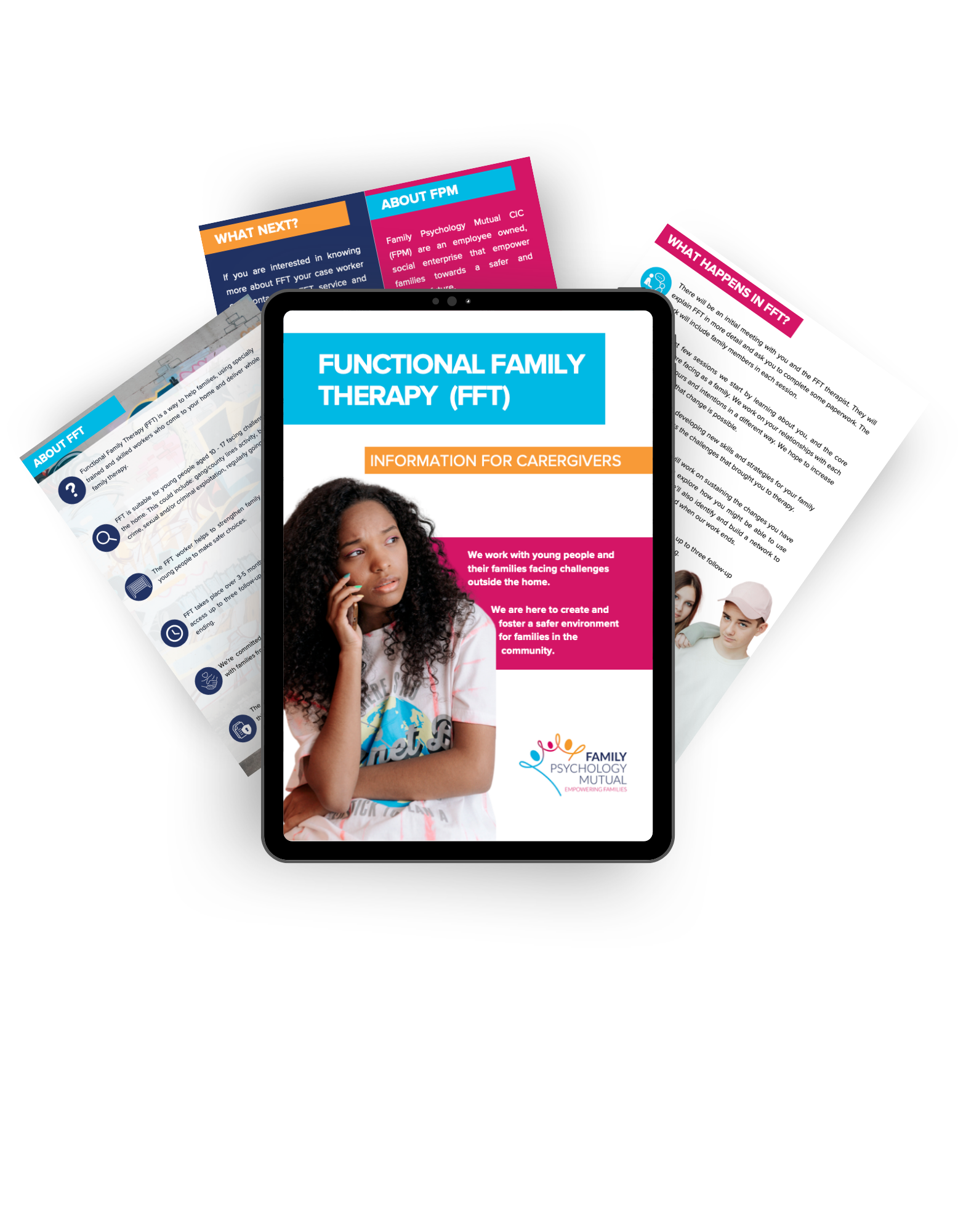
If you would like more information, you can access our Information for Caregivers Leaflet by clicking the button below.